

Utility Communication Market Outlook 2033: Wireless Networks Reshape Utilities Sector
The utility communications market is expanding rapidly as utilities invest in smart grids, wireless networks, and digital infrastructure modernization worldwide
Rising renewable energy integration, grid automation, and advanced communication technologies are driving significant growth in the utility communications market. ”
WILMINGTON, DE, UNITED STATES, June 10, 2026 /EINPresswire.com/ -- — Allied Market Research
Utility Communication Market Overview and Growth Outlook
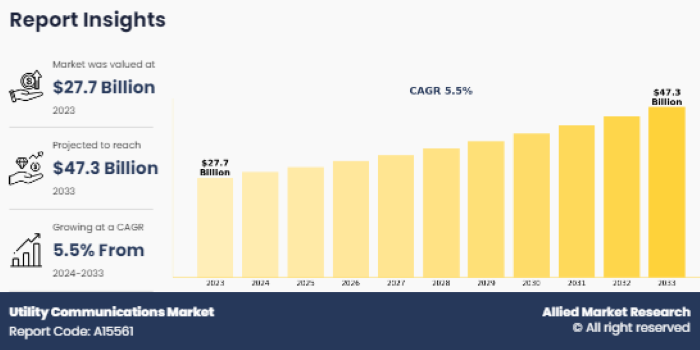
The utility communications market is witnessing substantial growth as utility providers across the globe continue to modernize aging infrastructure and transition toward digitally connected energy ecosystems. According to industry estimates, the utility communications market size was valued at $27.7 billion in 2023 and is projected to reach $47.3 billion by 2033, registering a CAGR of 5.5% during the forecast period.
Utility communication systems serve as the foundation of modern electricity, gas, and water infrastructure. These networks enable utilities to monitor assets in real time, manage grid operations, detect faults, optimize maintenance activities, and improve customer engagement. As utility operators increasingly adopt smart grid technologies, the demand for advanced communication platforms continues to rise.
Download PDF Brochure: https://www.alliedmarketresearch.com/request-sample/A15561
The growing deployment of distributed energy resources, renewable power plants, electric vehicle charging infrastructure, and smart meters has increased the need for reliable communication systems capable of transmitting massive volumes of operational data. Utilities are investing heavily in secure communication architectures that facilitate real-time decision-making and enhance grid reliability.
The utility communications market is also benefiting from government initiatives focused on energy transition and grid modernization. Investments in renewable energy integration, decarbonization programs, and smart city development projects are creating new opportunities for communication solution providers.
As utilities face growing pressure to improve operational efficiency while ensuring uninterrupted service delivery, communication technologies have become critical assets. Advanced networks help operators minimize outages, improve asset utilization, enhance cybersecurity preparedness, and support future-ready energy systems.
Utility Communications Market Analysis: Market Size, Dynamics and Forecast
A detailed utility communications market analysis reveals that communication infrastructure is becoming increasingly important across utility operations. The market is experiencing strong momentum due to technological advancements, increasing energy demand, and growing adoption of automation solutions.
The utility communications market analysis highlights several key growth factors. Utilities are adopting digital transformation initiatives to improve operational visibility and optimize resource management. Advanced communication systems facilitate seamless data exchange between field devices, substations, control centers, and customer service platforms.
The rising deployment of smart meters has further strengthened market demand. Millions of connected meters generate real-time consumption data, requiring robust communication networks to support data transmission and analytics.
Market participants are also investing in communication solutions that support predictive maintenance. Real-time monitoring capabilities help identify equipment issues before failures occur, reducing downtime and maintenance costs.
Despite strong growth prospects, cybersecurity concerns remain a significant challenge. Utility networks are increasingly targeted by sophisticated cyber threats, prompting organizations to invest in secure communication frameworks and advanced encryption technologies.
The market outlook remains positive as utilities continue to prioritize digitalization initiatives. Increasing investments in smart grids, renewable integration, and intelligent energy management systems are expected to sustain long-term growth.
Utility Communication and Communication Utility Trends
The utility communication landscape has evolved significantly over the past decade. Traditional communication systems are being replaced by advanced digital platforms capable of supporting complex utility operations.
Modern communication utility solutions incorporate cloud computing, artificial intelligence, machine learning, and edge computing technologies. These innovations enable utilities to collect, analyze, and act on operational data more efficiently.
One of the most notable trends is the shift toward real-time communication capabilities. Utilities increasingly require instantaneous access to operational information to improve grid responsiveness and service reliability.
Another important trend involves the growing adoption of mobile workforce solutions. Field technicians now utilize connected devices to receive assignments, access asset information, and report maintenance activities in real time.
Customer engagement platforms are also becoming an integral component of utility communication strategies. Consumers expect instant notifications regarding outages, service updates, billing information, and energy consumption insights.
As digital transformation accelerates, communication utility technologies will continue to play a central role in enabling efficient and resilient utility operations.
Industrial Utility Communication Market Driving Smart Infrastructure
The industrial utility communication market represents a significant segment of the overall industry. Industrial facilities require highly reliable communication systems to support critical operations, monitor equipment performance, and ensure workplace safety.
Industrial environments often involve complex infrastructure comprising power generation units, manufacturing facilities, substations, and distribution networks. Effective communication systems enable seamless coordination among these assets.
The rise of Industry 4.0 initiatives has further accelerated demand for industrial utility communication solutions. Connected sensors, industrial IoT devices, and automation platforms generate enormous amounts of operational data that must be transmitted securely and efficiently.
Industrial organizations are increasingly deploying private communication networks to enhance reliability and cybersecurity. These networks support mission-critical applications while minimizing exposure to external threats.
The industrial segment is also benefiting from renewable energy integration. Manufacturing facilities investing in solar power, battery storage, and microgrid solutions require advanced communication systems to manage distributed energy assets effectively.
As industrial automation expands worldwide, the industrial utility communication market is expected to remain a key contributor to overall industry growth.
Utility Communication Network and Utility Communication Networks Evolution
A utility communication network serves as the backbone of modern utility operations. These networks facilitate communication between control centers, substations, smart meters, sensors, field devices, and customer service systems.
Utility communication networks have evolved from simple analog systems into highly sophisticated digital ecosystems capable of supporting large-scale data transmission. Advances in networking technologies have significantly improved reliability, scalability, and performance.
Today’s utility communication networks support numerous applications including outage management, demand response, asset monitoring, fault detection, distributed energy resource management, and grid automation.
The expansion of renewable energy projects has increased demand for advanced networking infrastructure. Solar farms, wind parks, and battery storage facilities require continuous communication with utility operators to maintain grid stability.
Utilities are increasingly adopting hybrid communication architectures that combine fiber optics, wireless technologies, microwave systems, and satellite communications. These approaches improve network resilience while ensuring uninterrupted connectivity.
As utility infrastructures become more interconnected, communication networks will continue to serve as essential components of digital utility ecosystems.
Power Line Communication Market Creating New Opportunities for Utilities
The power line communication market has emerged as an important segment within the utility communications market. Power line communication technology enables data transmission over existing electrical infrastructure, reducing deployment costs and improving operational efficiency.
Utilities utilize power line communication systems for smart metering, grid monitoring, fault detection, and remote asset management. The technology eliminates the need for separate communication infrastructure, making it particularly attractive for large-scale deployments.
Power line communication solutions support advanced metering infrastructure programs by enabling two-way communication between utilities and customers. This capability improves billing accuracy, energy management, and outage detection.
Growing smart grid investments are expected to drive continued expansion of the power line communication market. Utilities seeking cost-effective communication solutions increasingly recognize the benefits of leveraging existing power distribution networks.
Advancements in communication protocols and signal processing technologies are further enhancing the reliability and performance of power line communication systems.
As utility modernization initiatives accelerate, power line communication technologies will play an increasingly important role in supporting intelligent energy networks.
Procure This Report (327 Pages PDF with Insights, Charts, Tables, and Figures): https://www.alliedmarketresearch.com/utility-communications-market/purchase-options
Utilities Communication Solutions Supporting Grid Modernization
Utilities communication solutions are becoming indispensable as operators modernize infrastructure and adopt digital technologies. These solutions encompass hardware, software, networking equipment, analytics platforms, and cybersecurity systems.
Modern utilities communication solutions enable comprehensive visibility across utility operations. Real-time monitoring capabilities allow operators to detect anomalies, optimize asset performance, and respond rapidly to emerging issues.
Advanced analytics platforms integrated with communication systems provide actionable insights that support strategic decision-making. Utilities can leverage data-driven intelligence to improve operational efficiency and customer satisfaction.
The growing adoption of distributed energy resources has increased the need for scalable communication solutions capable of supporting decentralized energy systems. Utilities require platforms that facilitate coordination among diverse assets while maintaining grid stability.
Communication solution providers continue investing in innovation to address evolving industry requirements. Artificial intelligence, machine learning, and cloud-based technologies are increasingly incorporated into modern utility communication platforms.
These developments are expected to create substantial opportunities for market participants throughout the forecast period.
Utility Case Market and Emerging Use Cases Across Energy Networks
The utility case market continues to evolve as communication technologies enable new applications across utility operations. Emerging use cases are transforming how utilities manage infrastructure, interact with customers, and deliver services.
One prominent use case involves predictive maintenance. Communication systems collect real-time asset data, allowing utilities to identify potential equipment failures before they occur.
Another rapidly growing application is outage management. Advanced communication platforms facilitate fault detection, crew dispatch, and restoration activities, significantly reducing outage durations.
Demand response programs also represent important utility case market opportunities. Communication technologies enable utilities to engage customers in energy conservation initiatives during peak demand periods.
Electric vehicle charging infrastructure presents another emerging use case. Communication systems support charging station monitoring, energy management, and billing functions.
As utilities continue embracing digital transformation, new use cases will further expand the value proposition of communication technologies.
Technology Analysis: Wired and Wireless Communication Systems
Technology innovation remains a key driver of growth within the utility communications market. Both wired and wireless communication systems play essential roles in supporting modern utility operations.
Wired technologies, including fiber optic networks, provide high-speed, low-latency communication capabilities. These systems are widely used in transmission networks, substations, and control centers where reliability is critical.
Wireless technologies are gaining popularity due to their flexibility, scalability, and lower deployment costs. Cellular networks, private LTE, 5G, RF mesh systems, and satellite communications are increasingly adopted across utility applications.
The wireless segment accounted for the largest market share in 2023 and is expected to maintain its leadership position throughout the forecast period. Growing demand for remote monitoring and distributed asset management continues to support wireless adoption.
Artificial intelligence integration represents another major technological advancement. AI-powered communication platforms can automatically analyze operational data, identify anomalies, and recommend corrective actions.
The combination of advanced communication technologies and intelligent analytics is expected to redefine utility operations over the coming decade.
Segment Analysis by Utility, Component, Application and End Use
The utility communications market is segmented across multiple categories, each contributing to overall industry growth.
Based on utility type, the market is divided into public and private segments. Public utilities accounted for the largest share in 2023 due to extensive infrastructure modernization initiatives and large-scale smart grid investments.
By component, software solutions generated the highest revenue. Utilities increasingly rely on software platforms for network management, data analytics, cybersecurity, and operational optimization.
Application-wise, the power generation segment remains dominant. Communication systems are essential for managing power plants, renewable energy facilities, transmission networks, and grid operations.
From an end-use perspective, industrial users accounted for the largest market share. Industrial facilities require sophisticated communication systems to support automation, energy management, and safety initiatives.
Continued investment across these segments is expected to drive sustained market expansion.
Regional Analysis and Global Adoption Trends
Asia-Pacific emerged as the leading regional market in 2023, accounting for more than half of global revenue. Rapid urbanization, industrialization, and infrastructure development continue to fuel market growth across the region.
China, India, Japan, South Korea, and Southeast Asian countries are investing heavily in smart grid technologies, renewable energy integration, and digital utility transformation programs.
North America remains a significant market due to extensive grid modernization projects and strong investments in renewable energy infrastructure. Utilities across the U.S. and Canada continue deploying advanced communication networks to improve operational efficiency.
Europe is witnessing steady growth driven by decarbonization goals, smart city initiatives, and renewable energy adoption. Government policies supporting energy transition are encouraging utilities to invest in digital communication technologies.
LAMEA also presents promising growth opportunities as emerging economies strengthen utility infrastructure and expand access to reliable energy services.
Competitive Landscape and Strategic Developments
Competition within the utility communications market continues to intensify as technology providers expand product portfolios and strengthen market presence.
Major industry participants include General Electric, Hitachi Ltd., Schneider Electric, Cisco Systems, ABB, Motorola Solutions, Itron, Omicron, Rad, and Milsoft Utility Solutions.
Companies are pursuing various growth strategies including partnerships, acquisitions, product innovation, and geographic expansion. Collaboration between communication technology providers and utility operators has become increasingly common.
Investments in cybersecurity solutions, artificial intelligence platforms, and next-generation networking technologies are shaping competitive dynamics.
Vendors are also focusing on developing integrated solutions that combine communication infrastructure, analytics, and asset management capabilities.
These strategic initiatives are expected to support continued innovation and market growth.
Investment Analysis and Regulatory Framework
Investment activity within the utility communications market remains strong as utilities prioritize modernization and resilience initiatives.
Governments worldwide are allocating substantial funding toward smart grid development, renewable energy integration, and digital infrastructure projects. These investments create favorable conditions for communication technology adoption.
Regulatory frameworks increasingly emphasize grid reliability, cybersecurity, and sustainability. Compliance requirements are encouraging utilities to upgrade communication systems and adopt advanced monitoring technologies.
Private sector investments are also accelerating. Venture capital firms, infrastructure funds, and technology companies recognize the long-term growth potential associated with utility communications.
Continued policy support and infrastructure spending are expected to strengthen market fundamentals throughout the forecast period.
Future Outlook for the Utility Communications Market
The future of the utility communications market appears highly promising. Increasing renewable energy penetration, smart grid deployment, electrification initiatives, and digital transformation programs will continue driving demand.
Emerging technologies such as 5G, artificial intelligence, edge computing, and advanced analytics are expected to create new opportunities across utility operations.
Utilities will increasingly require secure, scalable, and intelligent communication platforms capable of supporting decentralized energy systems and real-time decision-making.
The growing importance of resilience, sustainability, and customer engagement will further reinforce the strategic value of communication technologies.
As energy systems become more interconnected and data-driven, utility communications will remain a critical enabler of operational excellence and long-term industry growth.
Get a Customized Research Report: https://www.alliedmarketresearch.com/request-for-customization/A15561
Conclusion
The utility communications market is entering a transformative growth phase driven by smart grid expansion, renewable energy integration, digital utility transformation, and rising demand for reliable infrastructure management. Communication technologies have become indispensable for modern utilities seeking to improve operational efficiency, enhance customer engagement, strengthen cybersecurity, and ensure uninterrupted service delivery.
As utilities worldwide continue investing in intelligent energy networks, advanced communication systems will play a central role in enabling real-time monitoring, predictive maintenance, distributed energy management, and grid resilience. With strong support from government initiatives, infrastructure investments, and technological innovation, the utility communications market is expected to experience sustained growth through 2033, creating substantial opportunities for technology providers, network operators, and utility organizations across the global energy ecosystem.
Trending Reports in Energy and Power Industry:
Utility Communications Market
https://www.alliedmarketresearch.com/utility-communications-market-A15561
Utility Poles Market
https://www.alliedmarketresearch.com/utility-poles-market
Digital Utility Market
https://www.alliedmarketresearch.com/digital-utility-market-A109296
Digital Power Utility Market
https://www.alliedmarketresearch.com/digital-power-utility-market-A15994
Utility Battery Market
https://www.alliedmarketresearch.com/utility-battery-market-A12089
Temporary Power Market
https://www.alliedmarketresearch.com/temporary-power-market-A50163
Transformer Bushings Market
https://www.alliedmarketresearch.com/transformer-bushings-market-A15871
Distributed Energy Generation Market
https://www.alliedmarketresearch.com/distributed-energy-generation-market-A13784
About Us
Allied Market Research (AMR) is a full-service market research and business-consulting wing of Allied Analytics LLP based in Portland, Oregon. Allied Market Research provides global enterprises as well as medium and small businesses with unmatched quality of "Market Research Reports" and "Business Intelligence Solutions." AMR has a targeted view to provide business insights and consulting to assist its clients to make strategic business decisions and achieve sustainable growth in their respective market domain.
David Correa
Allied Market Research
+ + + + + + + + + + + + + +1 800-792-5285
email us here
Visit us on social media:
LinkedIn
Facebook
YouTube
X
Legal Disclaimer:
EIN Presswire provides this news content "as is" without warranty of any kind. We do not accept any responsibility or liability for the accuracy, content, images, videos, licenses, completeness, legality, or reliability of the information contained in this article. If you have any complaints or copyright issues related to this article, kindly contact the author above.
